
Life throws curveballs without warning — job loss, a broken car, or unexpected illness. Therefore, it’s essential for everyone, no matter their income or job security, to have an emergency fund. – Old clichés
Here is another perspective. Let’s apply the concept of ‘volatility’ – one of the most fundamental concepts in financial theory. The higher the volatility, the riskier the stock. Likewise, you wouldn’t want your life to be highly volatile; a life full of financial ups and downs is stressful and risky.
That’s why we pay insurance premiums for multiple products, such as health, life, and car insurance. An emergency fund is another form of self-funded, self-structured insurance.
The good news is that you don’t pay premiums to anyone. Instead, you earn the “interest” when your emergency fund sits in a high-interest savings account. You remain protected and grow your savings.
– Role of Emergency Fund
An emergency fund isn’t about chasing returns or serving as a down payment for your first home purchase. It’s the first line of defence against financial difficulties due to unexpected situations. The most common events are not just limited to job loss, unexpected medical bills, or sudden home or car repairs. It’s unanticipated and unpredictable.
It helps you avoid debt – these are the times when you need money to manage situations. A lack of emergency funds may force you to borrow from banks. Ironically, this is precisely when banks become reluctant to lend.
Your loan application is likely to be declined. Why? Banks see you as a higher-risk borrower because of the greater volatility in your financials.
Even if you get approved, the lending terms will be less favourable with a much higher interest rate. This makes it the worst time to add debt to your book. Having an emergency fund eliminates these concerns.
– How Much Is Enough?
Many industry experts suggest having an emergency fund that can cover 3 to 6 months’ worth of your essential living expenses.
The amount can vary based on personal preference, and there is no exact science behind it. Some individuals may maintain a larger fund that covers discretionary expenses, while others focus on strictly addressing essential needs.
At BrushMoney, we recommend maintaining an emergency fund of at least $6,000. The $6,000 we suggest is not just an arbitrary amount. Unlock Premium Banking below thoroughly explains the solid reason behind this precise amount.
– Where Should You Keep It?
Perhaps consider adding it to your long-term investment portfolio? Or investing in a cryptocurrency or tech stock? Your emergency fund is not an investment; it serves as self-funded, self-structured insurance.
Would you purchase a health insurance policy that can randomly lose its coverage? The theme here is on preservation, not growth. Taking risks with your emergency fund defeats the main purpose of it.
Why not a collection of rare sneakers, believing them to be a good store of value? Well, the process of appraising, finding a buyer, and negotiating a price for a physical asset is the last thing you need when you’re already stressed. Your emergency funds must be readily accessible (highly liquid).
Liquidity means how quickly and easily you can turn something into cash without losing value. Cash is the most liquid asset, whereas rare collectibles are the opposite; they are illiquid assets. You may also lose value if you need to sell in a hurry.
Bottom line, your emergency fund should be kept in a highly liquid and risk-free asset.
– Potential Risk
One inherent risk here is the inflationary risk, which means that your living expenses could increase over time. The best way to manage that risk is to reassess your 3-6 months’ living expenses and adjust accordingly. We suggest to review it once a year.
But the real threat to your emergency fund is ironically ‘you’. It’s tempting to use your emergency fund for non-emergencies, thinking you’ll put it back with your next paycheck. After all, it’s your money, right? But this mindset destroys the very purpose of an emergency fund itself.
Let’s take a step back to understand the meaning of the interest rate charged on your loan or credit card. The money you ‘borrowed’ technically belongs to the future, and you must pay it back with your future income. The future is uncertain by definition.
And big portion of interest rate on any debt reflects this ‘uncertainty’ from the lender’s perspective – lenders charge interest to compensate for risk. The higher the risk, the higher the interest charged.
Would you lend your money to ‘someone’ for free? And if the loan is from your Emergency Fund, how much interest would you demand? Failing to get repaid when you need the funds most could lead to a disastrous situation.
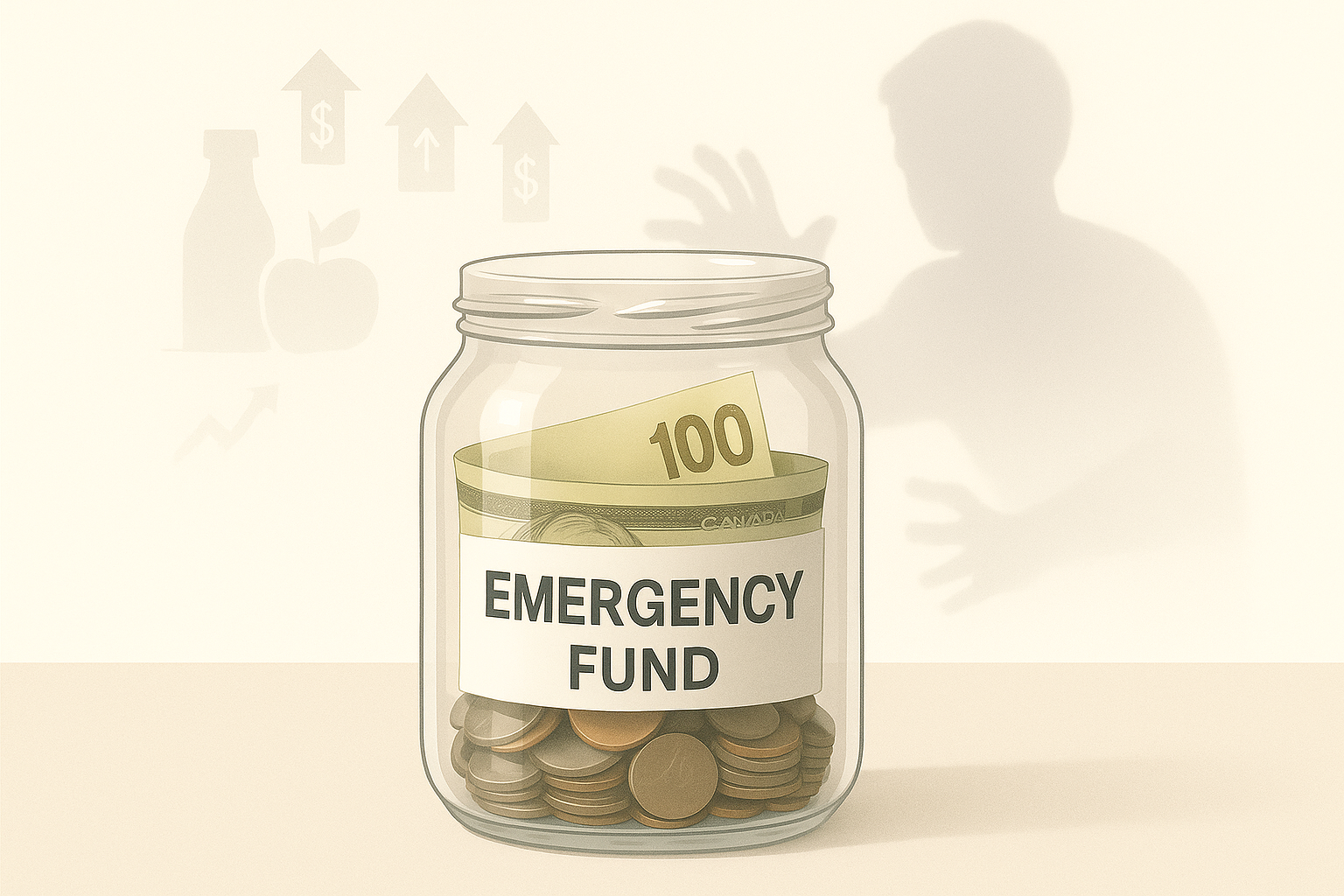
In this case, that ‘someone’ just happens to be you. And the idea behind the interest rate clearly proves that using an emergency fund for convenience is risky as much as It destroys the entire purpose of an emergency fund.
– Ok, so where should I keep it?
High-interest savings accounts or GICs (Guaranteed Investment Certificates) are decent choices. These options satisfy two critical conditions of an emergency fund: high liquidity and a risk-free form (except for inflationary risk). But not the best option.
This is where the idea of ‘optimal banking stack’ kicks in. And we recommend to keep $6,000 of your emergency fund in a Chequing account.
– Unlock Optimal Banking Stack for free
Chequing, Savings, and Credit Cards are essential banking products we rely on in our daily lives. Many big banks in Canada offer premium version banking products. Unfortunately, it also comes with substantial monthly fees.
On the other hand, they also offer economic version banking products with lower fees but come with limited banking services. And it typically leads to additional banking service fees later on, potentially resulting in higher overall costs.

This is where your emergency fund come into play, bringing a premium banking stack to your table. It is just a positive side effect of having an emergency fund. And this strategy is only applicable for BMO, CIBC, Scotiabank, and TD Canada Trust. Our Banking Stak 101 explains in detail step-by-step.
By simply keeping your emergency fund in a Chequing account, you can avoid monthly fees, effectively making it free. Major banks in Canada typically require a minimum balance of $6,000 to waive these fees.
The most exciting aspect is the positive ripple effect that follows – it allows you to waive annual fees for a range of high-end credit cards, which are known for their superior reward rates (higher cash back or more travel points) and extensive perks, all at no cost.
– Psychological Barrier
More importantly, this strategy elegantly protects the fund from you. Remember, the ‘potential risk‘ section? You understand that if your balance drops below $6,000, a monthly fee will be charged to your Chequing account. Therefore, it creates a strong psychological barrier, nudging you to use the fund only for emergencies.
If you ever need to access your emergency fund:
- Switch to a lower-fee or no fee chequing account.
- Switch to one with no annual fee credit card.
Both of these account type changes can be effortlessly made via online banking with just a few clicks. This minor hassle, along with the loss of benefits from the premium chequing, savings, and credit card, will likely make you reconsider using your emergency fund for anything except true emergencies.
Here is the simple guide to the Optimal Banking Stack for BMO, CIBC, Scotiabank, and TD Canada Trust. Unfortunately, RBC was excluded because its Value Program relies on bundling multiple products for discounts, which differs from the minimum-balance-based fee waivers.
Summary
- An emergency fund is your first line of defence and helps you avoid debt on rainy days.
- An emergency fund should be held in liquid and risk-free assets; cash is the most preferred form.
- A minimum of $6,000 is recommended, and review your living costs at least once a year to adjust for inflation.
- Counterintuitively but strategically, a chequing account is the most optimal place to hold your emergency fund.